Small carriers and established carriers

Small Carriers. More Ways to Work Together.

About 380,000 active interstate trucking companies run one to three trucks. Many have experienced drivers, equipment or customers of their own. Established carriers have freight, customers, equipment and systems. There may be useful connections between them.

More detail

Every count on this page comes from the October 2026 FMCSA records that ProHRHQ's carrier pages use. The counts change each month when those records are rebuilt. Grow Your Fleet counts a narrower group: carriers with a roadside inspection in the last two years.

From 377,639 small carriers to 15,170 one-truck carriers with a good record Five nested circles, areas to scale, October 2026 FMCSA records: 377,639 small carriers (interstate, for hire, 1 to 3 trucks); 270,113 run one truck (one tractor, one company); 236,364 ready to work (active authority, 6+ months in business); 53,945 have a track record (3 or more roadside inspections); 15,170 with a good record (safety grade a or b). 377,639 small carriers Interstate, for hire, 1 to 3 trucks 270,113 run one truck One tractor, one company 236,364 ready to work Active authority, 6+ months in business 53,945 have a track record 3 or more roadside inspections 15,170 with a good record Safety grade A or B From 377,639 small carriers to 15,170 one-truck carriers with a good record Phone layout of the same five nested circles, with each count listed below them. 377,639 small carriers Interstate, for hire, 1 to 3 trucks 270,113 run one truck One tractor, one company 236,364 ready to work Active authority, 6+ months in business 53,945 have a track record 3 or more roadside inspections 15,170 with a good record Safety grade A or B
More detail

Each circle is drawn to scale. Small carriers are active, interstate and authorized for hire, with one to three trucks. "Ready to work" means active operating authority, no Unsatisfactory FMCSA rating, and at least six months since the company got its USDOT number. Public records do not show a driver's own experience; that is checked on the application. The safety grade is ProHRHQ's: it compares each carrier with others of the same fleet size, and it needs at least three roadside inspections to mean much.

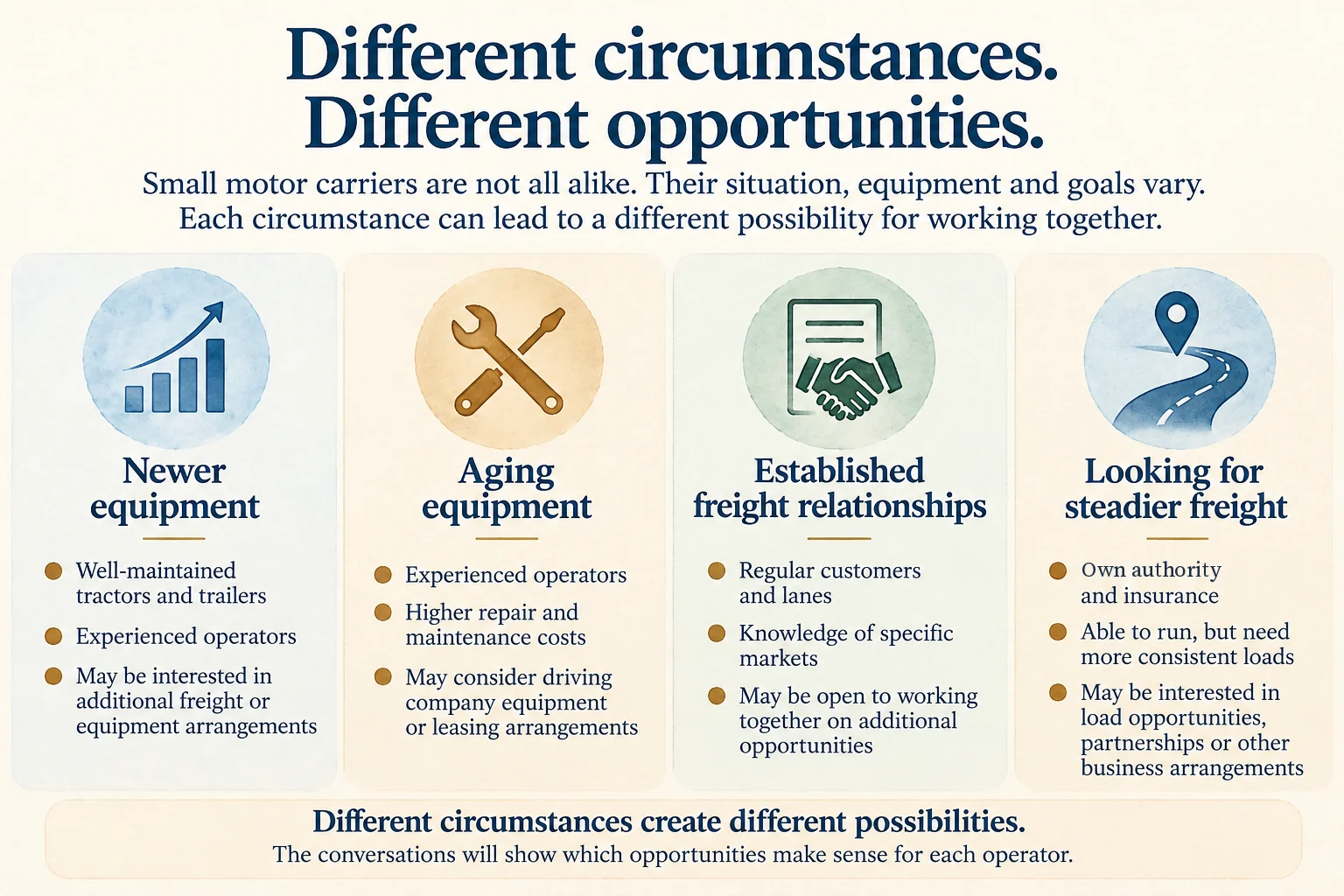
Different circumstances, different opportunities: small carriers with newer equipment, aging equipment, established freight relationships, or looking for steadier freight, each with a different possibility for working together.

Different circumstances. Different opportunities.

Small motor carriers are not all alike. Their situation, equipment and goals vary. Each circumstance can lead to a different possibility for working together.

Newer equipment: well-maintained tractors and trailers; experienced operators; may be interested in additional freight or equipment arrangements.

Aging equipment: experienced operators; higher repair and maintenance costs; may consider driving company equipment or leasing arrangements.

Established freight relationships: regular customers and lanes; knowledge of specific markets; may be open to working together on additional opportunities.

Looking for steadier freight: own authority and insurance; able to run, but need more consistent loads; may be interested in load opportunities, partnerships or other business arrangements.

Different circumstances create different possibilities. The conversations will show which opportunities make sense for each operator.

More detail

These are examples, and they overlap. One carrier may have a newer truck and steady customers; another an older truck and no regular freight. Public records show equipment, safety history and authority. Plans and preferences come out only in conversation.

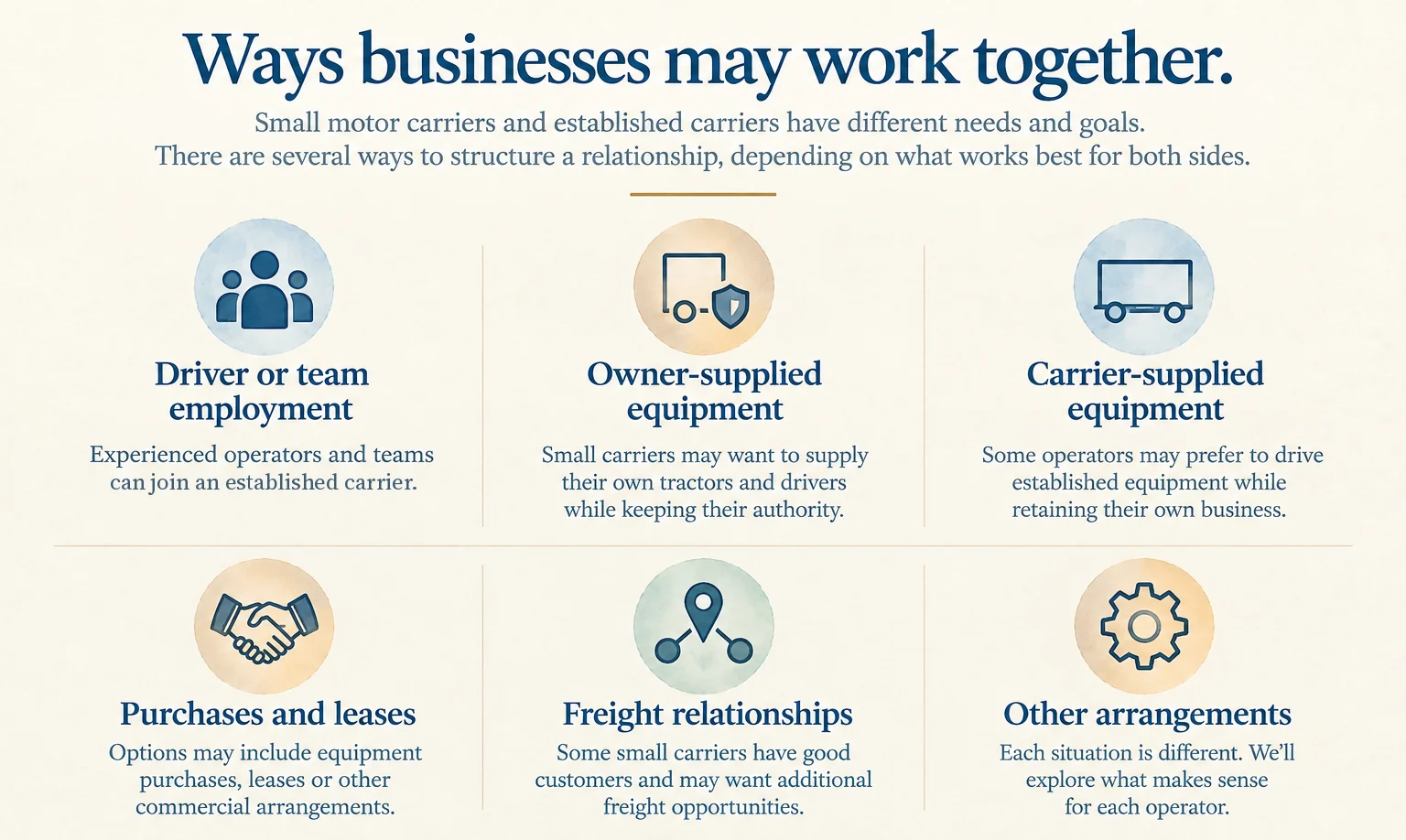
Six ways small and established carriers may work together: driver or team employment, owner-supplied equipment, carrier-supplied equipment, purchases and leases, freight relationships, and other arrangements.

Ways businesses may work together.

Small motor carriers and established carriers have different needs and goals. There are several ways to structure a relationship, depending on what works best for both sides.

Driver or team employment: experienced operators and teams can join an established carrier.

Owner-supplied equipment: small carriers may want to supply their own tractors and drivers while keeping their authority.

Carrier-supplied equipment: some operators may prefer to drive established equipment while retaining their own business.

Purchases and leases: options may include equipment purchases, leases or other commercial arrangements.

Freight relationships: some small carriers have good customers and may want additional freight opportunities.

Other arrangements: each situation is different. We'll explore what makes sense for each operator.

More detail

Each arrangement is worked out case by case. Operating authority, insurance, maintenance, lease terms and who pays which costs depend on the agreement and the regulations that apply. Keeping one's own authority does not mean every load runs under it.

Building relationships over time Four stages: know (useful facts right in the email), like (research they can put to work), trust (show our work on real files), buy (a conversation when they reply). A series of emails a few days apart, at most five a month; a reply ends the series and a person takes it from there. Building relationships over time 1 Know Useful facts, right in the email 2 Like Research they can put to work 3 Trust Show our work on real files 4 Buy A conversation when they reply A series of emails a few days apart, at most five a month. A reply ends the series. A person takes it from there. Building relationships over time Phone layout. Four stages: know (useful facts right in the email), like (research they can put to work), trust (show our work on real files), buy (a conversation when they reply). A series of emails a few days apart, at most five a month; a reply ends the series and a person takes it from there. Building relationships over time 1 Know Useful facts, right in the email 2 Like Research they can put to work 3 Trust Show our work on real files 4 Buy A conversation when they reply A series of emails a few days apart, at most five a month. A reply ends the series. A person takes it from there.
More detail

Each email carries something useful even if the carrier never clicks: the freight businesses near its own address, research such as the 1099 driver cost study, how a recruiting file is put together, and truck parking and relay sites. Every email has an unsubscribe link.

The systems behind the campaign Carrier records (every active carrier, updated monthly), the campaign engine (email series, spacing, unsubscribe links), responses (visits and replies, with security scanners filtered out) and ATS2 (contacts, stages and follow-up). Each carrier moves from contacted, to engaged, to a business conversation. The systems behind the campaign Carrier records Every active carrier, updated monthly Campaign engine Email series, spacing, unsubscribe links Responses Visits and replies, scanners filtered out ATS2 Contacts, stages and follow-up Each carrier moves from contacted, to engaged, to a business conversation. The systems behind the campaign Phone layout. Carrier records (every active carrier, updated monthly), the campaign engine (email series, spacing, unsubscribe links), responses (visits and replies, with security scanners filtered out) and ATS2 (contacts, stages and follow-up). Each carrier moves from contacted, to engaged, to a business conversation. The systems behind the campaign Carrier records Every active carrier, updated monthly Campaign engine Email series, spacing, unsubscribe links Responses Visits and replies, scanners filtered out ATS2 Contacts, stages and follow-up Each carrier moves from contacted,to engaged, to a business conversation.
More detail

ProHRHQ combines nationwide carrier records with research, email campaigns, website content and ATS2. Instead of one sales message, a carrier gets a series of emails a few days apart, each with something useful. Visits and replies show which companies have an interest; security scanners are filtered out. A reply ends the series and starts a real conversation, which ATS2 tracks as the relationship develops. Research papers are in the ProHRHQ Library.
Consult with ProHRHQ

Related: grow your fleet with owner-operators · a resource page for one- to three-truck carriers.